<--- Back to all resources
Discover: snowflake marketplace and streamkap is now available on it
Discover how Streamkap on the Snowflake Marketplace enables real-time data streaming for analytics with easy setup tips.
Big news for Snowflake users: Streamkap is now available directly on the Snowflake Marketplace. This is a major step forward for anyone looking to get real-time data streaming up and running, because it makes deploying a powerful Change Data Capture (CDC) platform as simple as installing an app right from your Snowflake environment.
A New Chapter for Real-Time Data Integration
Imagine an enterprise app store, but specifically for data services and applications. That’s essentially what the Snowflake Marketplace is. Before, setting up a real-time data pipeline was a heavy lift. It meant finding the right CDC tool, spinning up separate infrastructure, and then manually building and managing all the connectors. It was a complex, time-consuming job that often required a dedicated engineering team.
The fact that Streamkap is now available on the Snowflake Marketplace completely flips that script. It breaks down the old barriers and makes live data accessible to more teams.
Instead of wrestling with different vendors and complex configurations, you can now find, subscribe to, and deploy Streamkap in just a few clicks—all without ever leaving Snowflake. This integration slashes deployment time from weeks down to mere minutes. That means your team can stop worrying about pipeline plumbing and start focusing on what actually matters: getting insights from your data.
To get a better handle on the concepts behind this, our guide on real-time data integration is a great place to start.
Let’s break down exactly what this shift looks like in practice.
Traditional Data Pipelines Vs Streamkap On Snowflake Marketplace
The table below really highlights the contrast between the old way of doing things and this new, integrated approach. You can see how much friction is removed from the process.
| Aspect | Traditional Data Pipeline | Streamkap on Snowflake Marketplace |
|---|---|---|
| Procurement | Separate vendor contracts, lengthy sales cycles. | Single-click subscription via Snowflake. |
| Deployment | Manual setup of servers, connectors, and software. | Automated, one-click installation within Snowflake. |
| Billing | Multiple invoices from different vendors. | Consolidated billing through your existing Snowflake account. |
| Time to Value | Weeks or even months to get data flowing. | Minutes. Start streaming data almost instantly. |
| Maintenance | Ongoing management of separate infrastructure. | Fully managed service, no infrastructure overhead. |
| Security | Multiple security models and credentials to manage. | Unified security and governance within the Snowflake ecosystem. |
As you can see, integrating directly with the Marketplace isn’t just a minor improvement—it’s a fundamental change in how you access and use real-time data.
Part of a Thriving Data Ecosystem
What makes this launch even more significant is the incredible momentum behind Snowflake’s platform. The marketplace has seen massive growth, recently hitting $2 billion in sales through the AWS Marketplace in a single year, with transaction growth doubling year-over-year. This surge shows a clear demand from companies worldwide for integrated data solutions that can power their AI and analytics projects.
You can learn more about Snowflake’s marketplace growth on Snowflake’s website.
The marketplace itself serves as a central hub for finding and deploying all kinds of data-focused applications.
This screenshot gives you a feel for the user-friendly interface. It’s designed to be simple and accessible, putting sophisticated tools like Streamkap within easy reach. This is all part of the broader field of data and automation, where the goal is to make powerful technology easier for everyone to use.
How Streamkap and Snowflake Work Together
To really get what Streamkap does for Snowflake, it helps to think of it not as a typical data pipeline but as a live, direct feed into your data warehouse. Forget waiting for nightly batch jobs that tell you what happened yesterday; this is about seeing every single change from your source databases—as it happens. That’s the core idea behind real-time Change Data Capture (CDC).
Streamkap essentially creates a high-speed, direct connection from your operational databases (like PostgreSQL, MySQL, or MongoDB) straight into Snowflake. It does this by tapping into the database’s own transaction log. This is a brilliant, low-impact way to capture every insert, update, and delete without ever having to run heavy queries against your production systems, which can often slow them down.
The real power, though, comes from how this process fits so perfectly with Snowflake’s own architecture.
The Magic of Snowpipe Streaming
Streamkap was built from the ground up to integrate with Snowpipe Streaming, Snowflake’s service for ingesting data with incredibly low latency. Instead of the old method of clumping data into files and loading it in batches every few minutes or hours, Streamkap sends data row by row, directly into Snowflake tables. The result? Data latency is measured in seconds.
This combination opens up some seriously powerful use cases:
- Live Dashboards: Your business intelligence tools are no longer showing a picture of the past. They reflect what’s happening right now.
- Immediate Operational Analytics: Teams can instantly analyze things like customer activity, inventory changes, or system performance.
- Smarter GenAI: AI and large language models (LLMs) thrive on fresh data. A constant stream ensures their insights and responses are always timely and relevant.
Now that Streamkap is available directly on the Snowflake Marketplace, setting up this kind of real-time architecture is easier than ever. If you want to dive deeper into the technical nuts and bolts, check out the specifics of the Streamkap connector for Snowflake.
This diagram shows the stark difference between a traditional, delayed batch process and Streamkap’s real-time approach.
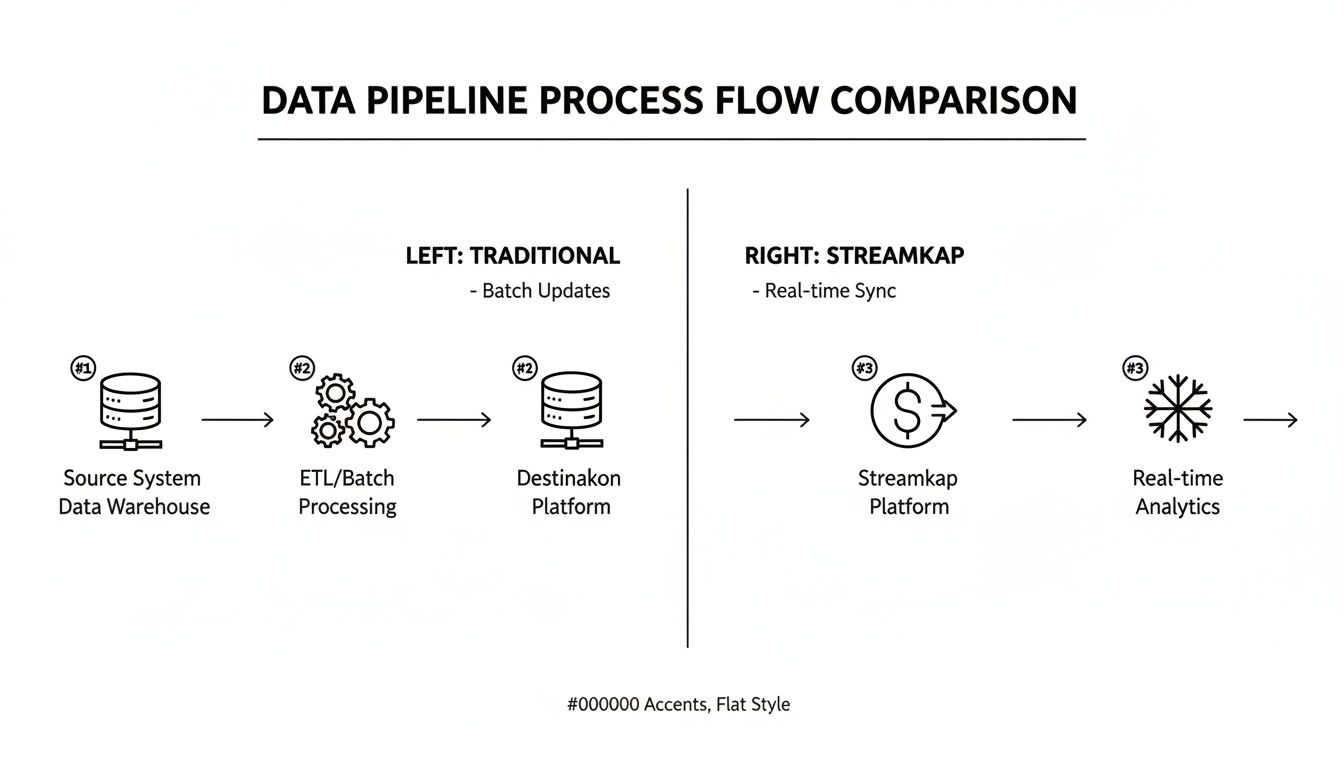
As you can see, Streamkap cuts out the middle steps, creating a much cleaner, more direct, and far more efficient path for your data.
Making a Complex Architecture Simple
Just a few years ago, getting this kind of real-time performance meant stitching together a complex puzzle of tools like Apache Kafka and Flink. It was a huge engineering lift, both to build and to keep running.
Streamkap completely changes that game by handling all that complexity for you. It’s a fully managed solution that gives you all the power without the headaches and operational costs.
When you start treating all your data as a continuous stream, your entire architecture gets simpler and more affordable. This makes modern approaches like the Kappa architecture—which gets rid of separate batch and real-time systems—not just possible, but practical to implement with Streamkap and Snowflake.
Ultimately, this means data teams no longer have to make a tough choice between getting data fast and keeping things simple. You can move to a modern, streaming-first model that’s not only faster but often cheaper than the old batch methods, paving the way for a more responsive and powerful data platform.
What This Means for Your Business
Let’s move past the technical diagrams and talk about what really matters: how this impacts your business. The true power of real-time data comes when you can act on information as it happens, not hours or days later. It’s the difference between looking in the rearview mirror and seeing the road ahead.
This shift from reactive analysis to proactive decision-making is where the real competitive edge lies.
Think about it in practical terms. For an e-commerce site, it means offering a customer a recommendation based on what they’re clicking on right now, not what they browsed yesterday. In the world of finance, it’s about catching and blocking a fraudulent transaction in milliseconds, before the damage is done.
Driving Revenue and Slashing Costs
These aren’t just nice ideas; they have a direct impact on your top and bottom lines. We’re seeing leading companies use the speed of Streamkap and Snowflake to get some pretty incredible results.
For instance, the fashion retailer Brandalley saw a £10 million revenue boost by putting real-time personalization into action. On the cost side of the equation, the software company SpotOn managed to cut its data processing expenses by a massive 75%. They did it by shifting to a smarter, more efficient processing model fueled by real-time streams. You can read more about these real-time data streaming successes to see how quickly the investment pays off.
The core idea is simple: by getting both historical and real-time data into Snowflake instantly, you kill latency and slash unnecessary compute costs. This turns real-time streaming from a “nice-to-have” luxury into a strategic tool that directly fattens your bottom line.
This efficiency is key. It makes sophisticated, real-time analytics a practical reality, not a budget-breaking experiment.
Common Use Cases and Their ROI
Real-time data isn’t just for one or two industries; its applications are incredibly broad, and each one comes with a clear return on investment. Having Streamkap right there on the Snowflake Marketplace makes it so much easier to get started.
Here are just a few common scenarios where businesses see immediate value:
- Dynamic Inventory Management: Imagine a retailer tracking stock levels across every store and online warehouse in real-time. This prevents frustrating “out of stock” messages and costly overstocking, leading directly to more sales and lower carrying costs.
- Operational Analytics: For a logistics company, this means monitoring its entire fleet live. They can optimize delivery routes on the fly, respond instantly to traffic jams, and keep customers happy with accurate ETAs. The result? Better efficiency and happier clients.
- Enhanced Customer Support: Picture a support agent who has a customer’s entire interaction history updated to the very last second. They can solve problems faster and offer truly personal service, which is a massive win for customer retention.
Ultimately, having Streamkap available on the Snowflake Marketplace removes the technical roadblocks that used to make this stuff difficult. It allows companies of all sizes to finally move beyond sluggish batch processing and tap into the strategic power of operating in real-time. It’s about turning your data into a genuine driver for growth and operational excellence.
Your Step-By-Step Guide To Getting Started
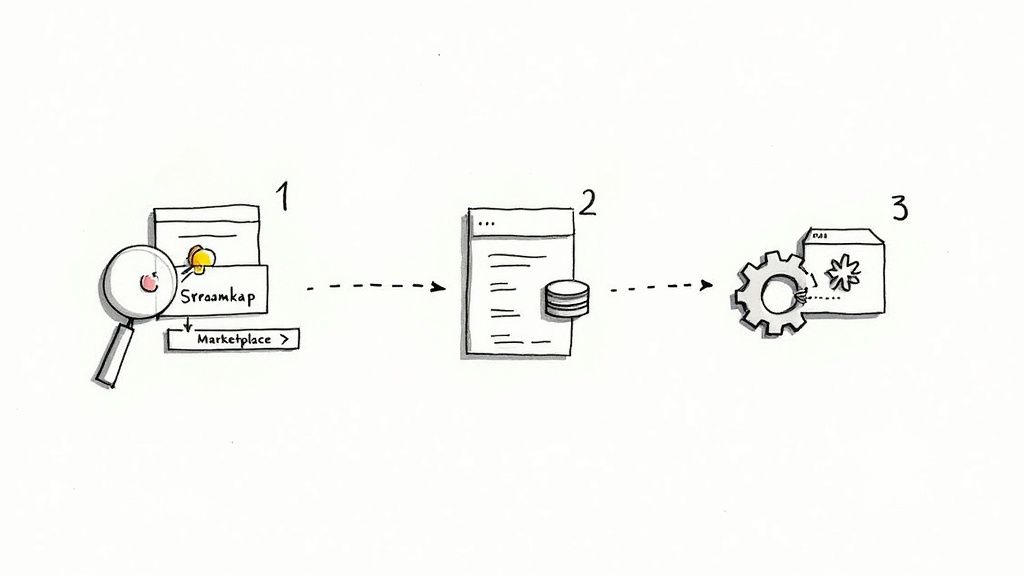
Alright, let’s move from theory to practice. Since Streamkap is now available on the Snowflake Marketplace, getting a real-time data streaming solution up and running is easier than you might think. This guide will walk you through the whole thing—from finding us in the marketplace to firing up your first pipeline, all without ever leaving your Snowflake environment.
The real win here is how much friction this new approach removes. You can forget about the old headaches of long procurement cycles, drawn-out vendor negotiations, and wrestling with infrastructure. This is all about getting the power of real-time Change Data Capture (CDC) into your hands in minutes, not months.
Locating And Subscribing To Streamkap
Your journey starts right inside the Snowflake Marketplace, which is basically an app store for data services that integrate directly with Snowflake. It’s surprisingly straightforward.
- Log into your Snowflake account and head over to the “Marketplace” tab on the main dashboard. This is your gateway to a whole ecosystem of pre-approved, integrated tools.
- Use the search bar and just type in “Streamkap.” Our official listing should pop right up.
- Click “Get” on our listing. This kicks off the subscription process, but it’s all handled through your existing Snowflake account. No new contracts, no separate billing to track down—everything is consolidated in one place.
The beauty of this is how smooth it is. By handling everything inside Snowflake, you’re sidestepping weeks of administrative back-and-forth. You’re literally just a few clicks from having a fully managed, real-time streaming platform ready to roll.
Configuring Your First Data Pipeline
Once you’re subscribed, it’s time to set up your first pipeline. We’ve designed a simple wizard to walk you through connecting a source, pointing it to a destination, and turning on the stream.
This takes what used to be a deeply technical, command-line-heavy task and breaks it down into a few logical steps.
Initial Setup And Connection
First things first, you need to connect your data source. Streamkap plays well with a ton of popular databases and event streams.
- Select Your Source: Pick the database you want to stream changes from, whether that’s PostgreSQL, MySQL, MongoDB, or another one.
- Provide Connection Details: You’ll securely enter the credentials needed for Streamkap to read the database’s transaction logs. This log-based CDC approach is completely non-intrusive and has zero performance impact on your production systems.
- Define Your Snowflake Target: Next, tell us which Snowflake database, schema, and tables you want the real-time data to land in. Streamkap takes care of schema detection and evolution automatically, so you won’t be stuck manually creating or updating tables in Snowflake every time your source data changes.
With your source and destination set, all that’s left is to activate the pipeline. Just start the stream, and Streamkap will immediately begin capturing changes and sending them straight into Snowflake using Snowpipe Streaming. In a matter of seconds, you’ll see live data populating your tables, ready for you to analyze.
Architecting Your System For Performance And Scale
Building a data system that’s both fast and reliable means getting your hands dirty and looking under the hood. For data architects and engineers, pairing Streamkap with Snowflake creates an incredibly powerful foundation for high-volume, low-latency data pipelines that can handle just about anything you throw at them. This isn’t just about shuffling data from point A to point B; it’s about engineering a truly resilient and efficient flow.
At the heart of it all is Streamkap’s log-based Change Data Capture (CDC). Think of it like a court reporter for your source database, silently noting every single change without interrupting the proceedings. Instead of running heavy, disruptive queries that can slow things down, it reads directly from the database’s native transaction log. This approach has a zero performance impact on your critical source systems, even when they’re under heavy load.
That constant stream of changes flows right into Snowflake’s unique multi-cluster, shared data architecture. The combination here is what makes the magic happen. Streamkap delivers the data in a format that’s perfectly suited for how Snowflake ingests and organizes it into highly optimized micro-partitions, setting the stage for blazing-fast queries.
Strategies For Petabyte-Scale Environments
As your data grows—and it always does—your architecture needs to keep up without skipping a beat. Having Streamkap available on the Snowflake Marketplace is a great start, but following a few best practices will ensure you maintain that peak performance for the long haul.
Here are a few key things to keep in mind as you scale your streaming workloads:
- Right-Sizing Your Warehouse: With Snowpipe Streaming, you don’t need a warehouse running 24/7 just for ingestion. But for the transformations and queries you run on that fresh data, picking the right Snowflake virtual warehouse size is critical. It’s often best to start small, keep an eye on performance, and scale up only as your queries get more complex or more people start hitting the data.
- Monitoring Data Freshness: You need to actively monitor the end-to-end latency of your entire pipeline. This isn’t a set-it-and-forget-it task. Establishing a baseline helps you spot potential bottlenecks early, ensuring your data is as close to real-time as the business actually needs it to be.
- Using Dynamic Tables: Make your life easier by using Snowflake’s Dynamic Tables to automate transformations on your streaming data. They handle incremental updates for you, which dramatically simplifies your pipelines and cuts down on the need for complicated, custom orchestration scripts.
Sticking to these principles will help you build a system that can truly scale. For a deeper dive, check out our guide on data architecture best practices.
The Snowflake Marketplace is the go-to hub for AI Data Cloud services, and with Streamkap now available on it, it’s easier than ever for businesses to tap into real-time data. This ecosystem is booming, especially with Snowflake holding a dominant 35% market share and recently hitting $2 billion in annual sales through the AWS Marketplace alone.
This kind of tight integration makes some serious performance possible. We’ve seen organizations push through 100 TB of daily throughput and still get query latencies under 30 seconds.
Managing Security And Governance In A Real-Time World
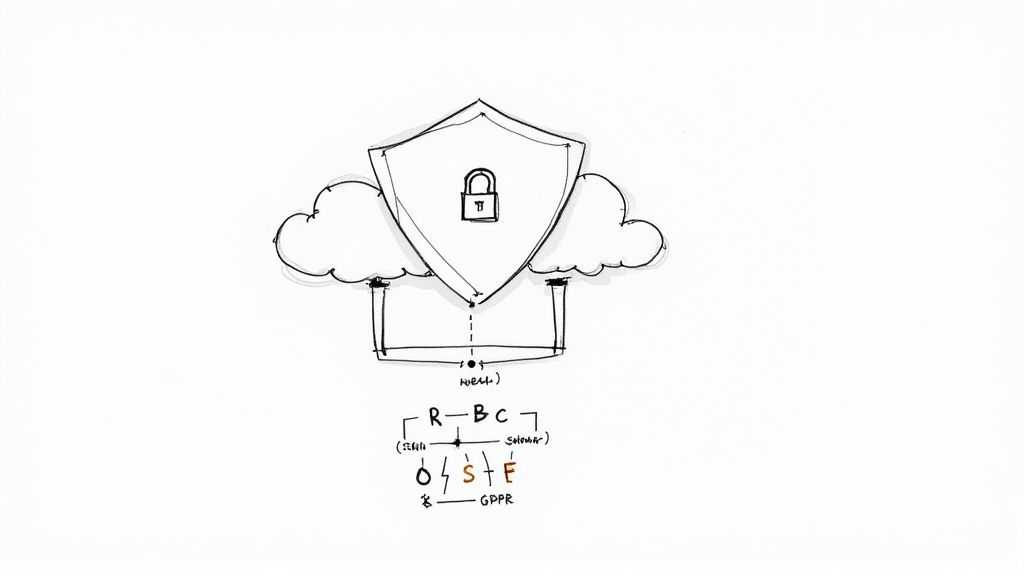
Moving data in real time is a major improvement, but it also brings up some serious questions about security and governance. When data is constantly on the move, how do you keep it safe?
The great news is that because Streamkap is now available on the Snowflake Marketplace, it simply inherits Snowflake’s strong, multi-layered security framework. You’re not trying to juggle two different security models. Instead, Streamkap runs as a secure, native app right inside your Snowflake environment, meaning your data is protected by end-to-end encryption, both in transit and at rest.
Access is controlled by Snowflake’s own granular Role-Based Access Control (RBAC), which you’re likely already using. You can define exactly who can see or touch the streaming data, just like any other dataset in your warehouse. To truly lock things down, it’s smart to adopt best practices like Privileged Access Management (PAM) as part of your overall strategy.
By integrating directly through the Snowflake Marketplace, you get the speed of real-time streaming without compromising on the enterprise-grade security and governance features you already trust. Speed and safety go hand-in-hand.
Maintaining Compliance In A Streaming Architecture
Following strict data privacy regulations like GDPR and CCPA isn’t optional. The Streamkap and Snowflake integration gives you the tools you need to stay compliant, even with live data pouring in.
You can use Snowflake’s built-in governance features to protect personally identifiable information (PII) the moment it arrives. These are essential for building a compliant pipeline:
- Dynamic Data Masking: This feature lets you automatically hide sensitive data fields in real time based on a user’s role. An analyst might see
****-****-****-1234, while a finance manager sees the full credit card number. - Secure Views: You can create authorized views of your data that limit access to specific rows or columns, making sure people only see the data they’re supposed to.
This tight integration makes compliance much easier. It gives your security teams peace of mind, knowing that your real-time data pipelines are managed with the same strict controls as your traditional batch systems.
Frequently Asked Questions
Got questions about using Streamkap through the Snowflake Marketplace? We’ve got answers. Here are a few common ones we hear from our users.
How Is This Different From Traditional ETL And ELT Tools?
Think of traditional ETL and ELT tools like a mail truck that only comes once a day. They work in batches, moving data on a set schedule—maybe once an hour, or even just once a day. This means your data in Snowflake is always a little bit behind, always looking in the rearview mirror.
Streamkap is completely different. We use Change Data Capture (CDC) to stream every single insert, update, and delete from your source databases into Snowflake in real time. We’re talking milliseconds, not hours. And with Streamkap now available on the Snowflake Marketplace, getting this set up is faster than ever. You can handle the entire procurement and deployment process right inside Snowflake and have real-time pipelines running in minutes.
What Performance Impact Should I Expect On My Source Databases?
This is a big one, and the answer is: you should expect minimal to zero impact. Streamkap was built from the ground up to be incredibly lightweight and non-intrusive.
Instead of running heavy, performance-draining queries against your production tables, we read directly from the database’s native transaction logs—things like the binlog in MySQL or the WAL in PostgreSQL. This approach lets us capture every change without slowing down your critical source systems.
Is The Setup Process Technical And Time-Consuming?
Not at all. In fact, that’s one of the best parts about our Snowflake Marketplace integration. We’ve stripped away all the usual engineering complexity to make the whole process fast and simple.
You can subscribe to Streamkap directly from your Snowflake environment and then follow a simple, guided setup wizard. Most folks are able to configure and launch their first real-time data pipeline in under an hour, all without needing to loop in a huge technical team.
Ready to stop waiting for your data? Explore Streamkap on the Snowflake Marketplace and see what real-time really means. Get started today at streamkap.com.